Olympus, Titans, and the Tech Gods
Forget geology; Olympus was psychology, a hotbed of pleasure, spectacle, and control.
Above Hades, the Olympians basked in victory. Far beneath, Tartarus – the prison of the Titans, confining Saturn’s older beings like Cronus and his kin – embodied a harsh philosophy of growth through hardship and suffering. Some traditions whisper of civilizations experimenting with technology while the Olympians declared themselves divine, maintaining their mortal grip with spectacle.
Popular culture still riffs on the cosmic clash in Clash of the Titans, video games, and Marvel nods. Still, every age reenacts the battle: Saturnian suffering versus Jovian pleasure, hardship versus control, chaos versus order.
Today, Olympian technocrats dazzle us with tools and platforms while confining us in digital underworlds. Our Titans are the raw forces of instability and suffering that refuse to vanish.
Today’s technocrats dazzle us with platforms while confining us in digital underworlds. Our Titans are instability and suffering that refuse to vanish.
Olympus was an advanced system that lacked imagination. The gods ruled through technology and deification, not creativity.
Myths remind us: every system — whether Olympian pleasure or Titan suffering — has consequences according to the patterns you choose to embody.
The labyrinth is more than a metaphor
Knossos and Olympus both still stand, in one form or another.
Excavated by Sir Arthur Evans in 1900, Knossos — Crete’s 20,000 m² Bronze Age palace — had 1,000 interconnected rooms stacked four stories deep, with plumbing, light wells, and vast storage facilities. Evans recognized it as the inspiration for King Minos’s legendary labyrinth.
The Minoans, flourishing between 2000 and 1450 BCE, are famous for frescoes of bull-leaping — athletes vaulting sacred bulls in ceremonies whose purpose still divides scholars.
From Crete’s myths came a queen’s union with a bull, an architect’s contraptions, a maze to contain the hybrid child, and a princess who mapped the way out.
The Palace of Knossos, the bull cult, and labyrinthine architecture are real. Recent scholarship suggests the mythological account preserves cultural memory of genuine Bronze Age practices, including ritual sacrifice and animal-human symbolic fusion, far more accurately than the Victorian scholars who first excavated the site would admit.
Hybrid creatures across cultures
The hybrid — as ancient myths across cultures and centuries concur — is always the consequence of divine transgression; the crossing of Nature’s forbidden boundaries. The results of such transgressions become warnings — creatures locked in labyrinths that a hero must kill to restore order.
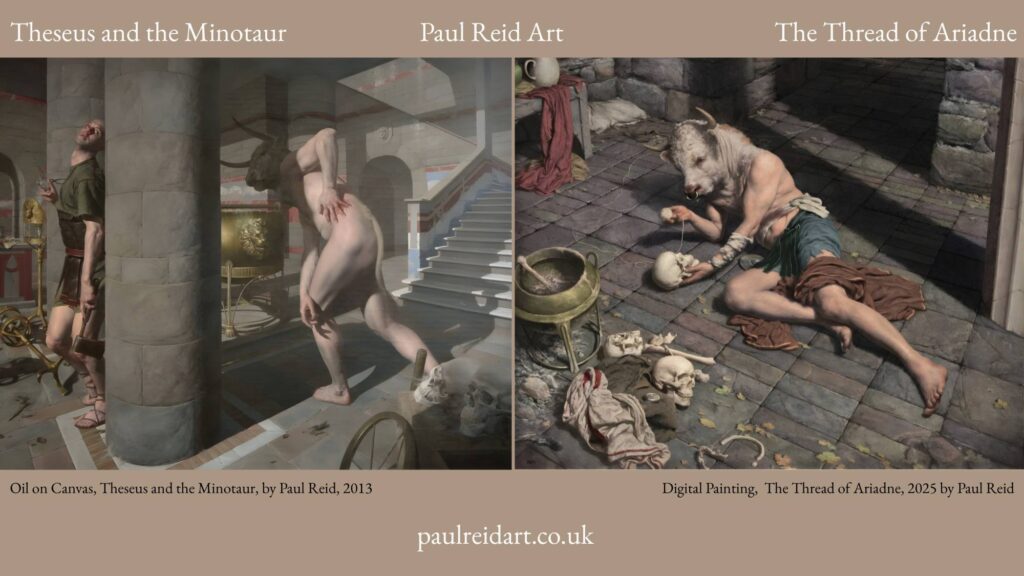
Starved into monstrosity in a purpose-built prison and fed on virgin “tributes” until a hero with a borrowed ball of thread and a sword ended the Minotaur, who did not ask to be born. Neither Scylla nor her half-sister Medusa chose their monstrous transformations, nor the Sirens their island. The gods meted out these forms as experimental punishments before turning them into cautionary tales.
Every culture produces the same archetypes. The Mesopotamians had their bull-men and scorpion-people, guarding palace gates against unnamed threats. The Egyptians had Anubis, the jackal, and Sekhmet, the lion-goddess of healing and slaughter, who once nearly destroyed humanity and had to be stopped with a blood-red beer. The Hindus revered Ganesh, the elephant-headed god of wisdom, born when Shiva beheaded his own son in a rage and replaced the boy’s head with the first creature he found. Trauma made divine — wounds dressed as doorways — every single time.
“Traditional mixed monsters — minotaurs, chimeras, lamias, gorgons — stand for a deep and threatening disorder, something dreadful and invasive.”
— Mary Midgley, philosopher
Follow the thread
Built to contain, silence, and hide hybrid creatures, labyrinths recur in every culture and century, driven by the same annihilative hunger — only the scale and sophistication change.
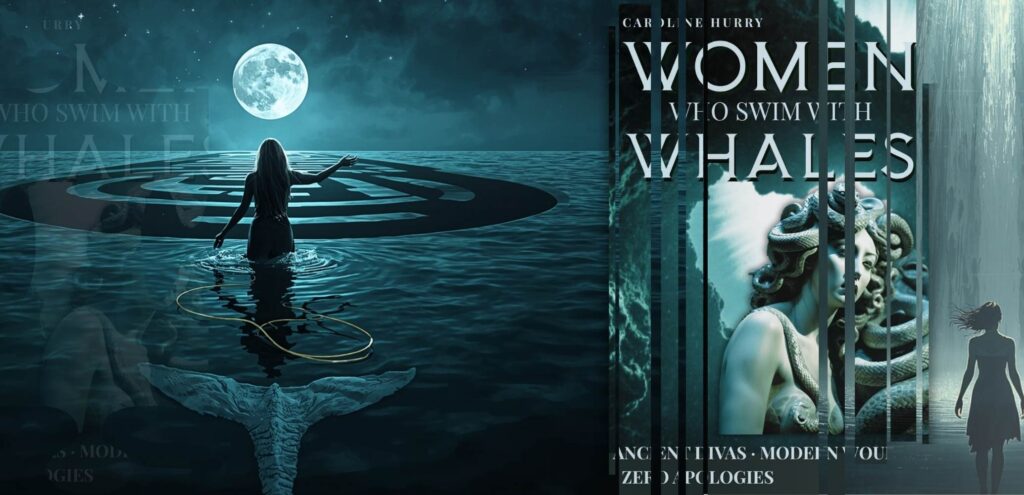
Medusa — who moderates the heart cave confessional in Women Who Swim with Whales — is herself an in-between being. Mortal among immortals, punished for a god’s violation of her, her severed head weaponized after death to adorn Athena’s shield as both trophy and warning, her name means the ruling one, and anagrams to “made us.”
Anything’s possible – Caroline Hurry
References
1. World History Encyclopedia: Minoan Civilization. worldhistory.org/Minoan_Civilization
2. The Ashmolean Museum, Oxford. ‘Labyrinth: Knossos, Myth & Reality.’ Exhibition, February–July 2023.
3. Midgley, Mary. ‘Hybridity, Monstrosity and the Posthuman.’ Quoted in The In-Between Beings: Cultural Scope of Splicing and Doing Things by Halves.
4. Yue Hu et al. ‘Generation of a humanized mesonephros in pigs from induced pluripotent stem cells via embryo complementation.’ Cell Stem Cell, Vol. 30, Issue 9, September 2023.
5. Cavaliere, G. ‘A 14-day limit for bioethics: the debate over human embryo research.’ BMC Medical Ethics, May 2017. DOI: 10.1186/s12910-017-0198-5
6 ‘A Technological and Regulatory Review on Human-Animal Chimera Research.’ PMC / National Institutes of Health, 2023. PMCID: PMC10467371