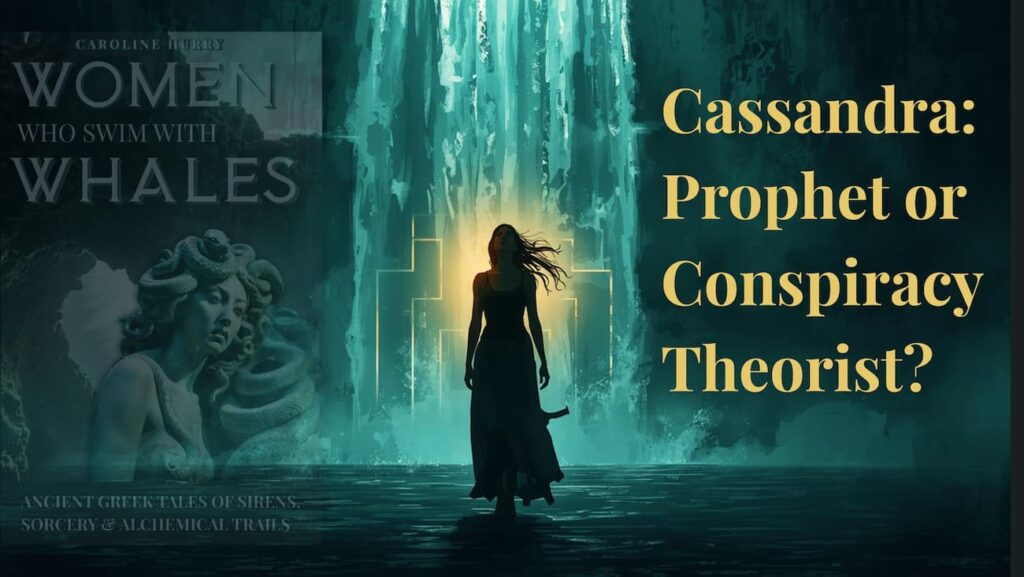
Was Cassandra a Conspiracy Theorist
Or just the first woman nobody believed?
Fearing one of his six children would overthrow him, Cronus, king of the Titans, devoured five before Rhea saved her remaining son, Zeus, by tricking her husband into swallowing something else.
When Tantalus, king of Phrygia, dished up his son Pelops to the Pantheon gods in a stew, a grieving Demeter ate his shoulder. As you do. Atreus, king of Mycenae, served his slow-simmered nephews to their father, Thyestes. His son Agamemnon dashed his wife-to-be Clytemnestra’s baby’s brains on concrete before carting her off to be his bride. It’s how these elite families roll!
Zeus did overthrow Cronus, but the apple didn’t fall far from the dysfunctional tree, and the cycle continues. Who needs thunderbolts when a man owns a private island? You might ask what he hides in his underground maze.
Clytemnestra is one of nine ancient Greek archetypes in Women Who Swim with Whales, and institutions that claim to protect them betray her. Such voracious inhuman appetites still function here, albeit with better lawyers, handlers, and media moguls keeping a lid on things.
The powerful have private jets and islands where they build their own labyrinths amid archipelagos of secrecy and purchased compliance, filling them with the young.
In Epstein’s Invisible Empire: The Favor Bank and the System That Made Him Possible (Triform Press, 2026), Marcus Severin excavates the infrastructure, logistics, interconnected systems – property, aviation, finance, and influence – that enable child exploitation at the highest levels.
The ancient Greeks knew all about feuding pantheons of bloodthirsty billionaires wearing benign expressions. The virgins in their path – Medusa, punished for being attacked, Persephone, dragged into the underworld with Zeus’s full sanction, and Cassandra, whom Apollo cursed for naming him – were silenced for speaking out about powerful untouchable men and the mazes they build around mortals.
Thoughts turn to Virginia Giuffre, one of the earliest voices calling for criminal charges against Epstein and those named in connection with his network — the late Queen Elizabeth’s son among them. She had accused Jeffrey Epstein and Prince Andrew of sexual abuse — allegations he denied - and in 2022 settled a civil lawsuit against the prince without any admission of liability.
Other abuse survivors later credited her with giving them the courage to speak out, but Giuffre, alas, died by suicide in 2025, aged 41.
Cassandra saw it all – the wooden horse, the blood, and the fall of Troy. When she tried to warn people, she was called hysterical, unstable, and insane. Some of us know what this feels like.
The German novelist Christa Wolf situated Cassandra as a figure of feminist resistance against patriarchal repression — someone who reflects on her situation, seeks truth, and refuses the role of passive victim. Cassandra’s prophecies and tragic fate are central. She describes her visions of the past and future, including her own impending death, and is met with disbelief to the end.
Our world is full of Cassandras. Princess Diana wrote a letter in October 1996, approximately 10 months before her death, in which she stated that a car accident was being planned for her. Her former butler, Paul Burrell, disclosed the handwritten letter in his 2003 book, A Royal Duty.
A 6,000-page investigative dossier on the 1997 crash that killed Princess Diana, compiled by French police after an 18-month inquiry, remains locked in the basement archives of the Palais de Justice in Paris — protected under French heritage law, which bars public access for 75 years. The dossier will not be available until 2082 at the earliest.
I wonder why.
The Temple of Tides is behind a waterfall. Nine women inside have been waiting to speak since before Homer, and they’re not in a forgiving mood. Are you?
Grab Women Who Swim with Whales for just 99c! It’s a limited-time offer so strike while the iron is hot!