Exile, Labyrinth, Confessional
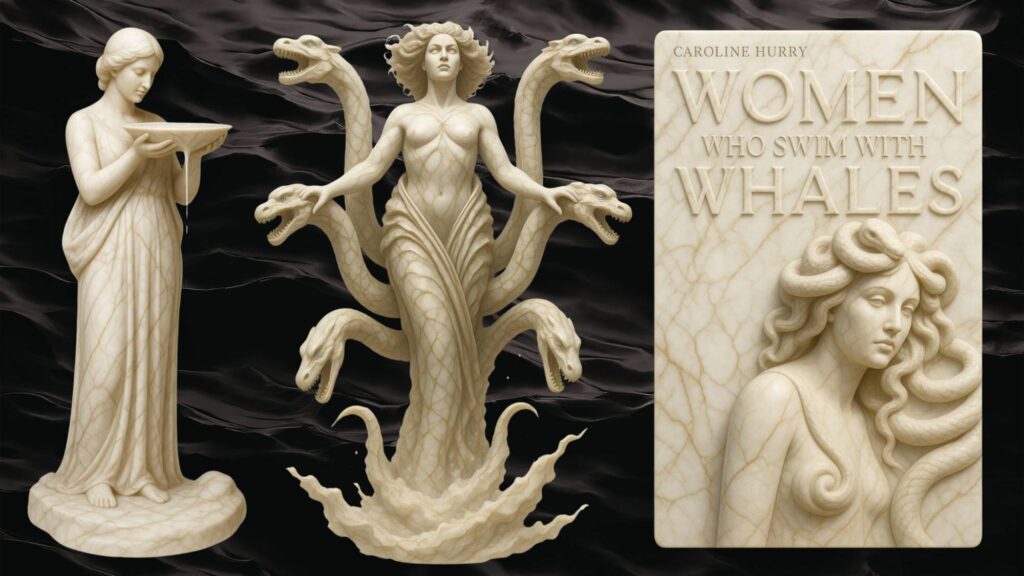
Circe turned men into animal hybrids, cursed Scylla into a six-headed terror, and meddled with nature’s thresholds. Her lessons echo in today’s laboratories.
If kings crafted hybrid war-beasts from living DNA 4,500 years ago, what might they breed today?
Archaeologists puzzled over equid remains at Umm el-Marra in northern Syria until science confirmed in 2022that the “chariot horses” buried with royalty and celebrated in Sumerian battle art were Kunga’s, a domestic donkey-Syrian wild ass hybrid bred for prestige, power, and war.
Paleo geneticist Eva-Maria Geigl named them “the first bioengineered animal.” Her co-author E. Andrew Bennett called them “war machines.” Reserved for kings, generals, and gods, Kungas cost six times more than donkeys in a 500-year program of deliberate cross-species creation.
From Circe’s island to CRISPR’s laboratories, the ancient world’s hybrid experiments remind us that the gods enjoy tinkering.

Circe Delivered the Minotaur
In Women Who Swim with Whales, Circe, daughter of Helios, helped give birth to the Minotaur that defined the age of Minos. Pasiphaë, her sister, craved a sacred white bull. Daedalus, her lover, enabled the deceptive conception and Asterion’s labyrinthine containment.
Not only was Circe summoned to manage the consequences of what the gods created on a whim, but she turned Scylla, the sea nymph, into a monster out of jealousy, and Odysseus’s men into swine.
“Punished for another’s desires, Scylla’s shrieks echoed across the cliffs all the way to eternity. I knew I had gone too far and fell to my knees. But what I’d done, I couldn’t undo. Magic doesn’t work that way. Their evil was in me, too.”
Circe in Women Who Swim with Whales
Scylla begged for death rather than her monstrous form, but the gods noted her presence was useful for humbling (and harvesting) sailors.
The Modern Daedalus
In 2023, scientists at Guangzhou Institutes of Biomedicine and Health successfully grew human kidneys inside pig embryos using CRISPR gene editing. The embryos were allowed to develop for 28 days before being collected. The kidneys exhibited normal human function, as reported in a peer-reviewed study published in Cell Stem Cell.
Scientists have spliced spider genes into goat DNA to make them produce spider silk — one of the strongest materials known — in their milk. Human disease genes are routinely inserted into mouse and other embryos.
The UK Human Fertilization and Embryology Authority permits the creation of human-animal chimera embryos for research purposes under strict conditions: no chimera embryo may be cultured beyond 14 days, the point at which the primitive streak — the earliest formation of the nervous system — begins to appear.
“Creating humanized tissues and organs in animals would enable scientists to test possible therapies in a system much closer to that of a human for much longer durations.” — Journal of Technological and Regulatory Review on Human-Animal Chimera Research, 2023
Daedalus, who built the wooden cow, the labyrinth, and crafted wings that killed his son, was the ancient world’s finest engineer. But every structure he created contained something monstrous that never asked to be born. Today’s Daedalus wears a lab coat and calls it translational medicine.
Poseidon was never punished for violating Medusa. Nor Daedalus for building the apparatus to enable monstrosities. Circe was exiled for creating Scylla, but mostly because she was an inconvenience to the likes of Zeus and her father, Helios.
Solitude on her island — Aeaea — became the gift that kept giving as Circe made it hers. She goes first in the Temple of Tides’ heart cave confessional.
Medusa, who moderates the mythical cave confessional in Women Who Swim with Whales, is herself a hybrid: mortal among immortals, punished for a god’s violation, her severed head weaponized post-mortem to adorn Athena’s shield.
Her name means the ruling one and anagrams to ‘made us.’
Read an extract from Circe’s meeting with Odysseus in Women Who Swim with Whale.
References
1. Geigl, E-M., Bennett, E.A. et al. ‘The genetic identity of the earliest human-made hybrid animals, the kungas of Syro-Mesopotamia.’ Science Advances, Vol. 8, Issue 2, January 14, 2022. DOI: 10.1126/sciadv.abm0218
2. ‘DNA Shows Ancient Pack Animal Was a Donkey-Wild Ass Hybrid.’ Inside Science / American Institute of Physics, January 2022.
3. Yue Hu et al. ‘Generation of a humanized mesonephros in pigs from induced pluripotent stem cells via embryo complementation.’ Cell Stem Cell, Vol. 30, Issue 9, September 2023.
4. Cavaliere, G. ‘A 14-day limit for bioethics: the debate over human embryo research.’ BMC Medical Ethics, May 2017. DOI: 10.1186/s12910-017-0198-5
5. ‘A Technological and Regulatory Review on Human-Animal Chimera Research.’ PMC / National Institutes of Health, 2023. PMCID: PMC10467371